Certified Labour Law Professional (CLLP)

- Description
- Curriculum
- FAQ
- Notice
- Reviews
The Certified Labour Law Professional program is designed to provide in-depth knowledge of Indian labour laws and statutory compliance, which are essential for every HR professional and business leader.
Labour laws play a critical role across all HR functions—from recruitment and onboarding to employee benefits, compliance, and exit management. A strong understanding of legal frameworks helps organizations avoid penalties, manage employee relations effectively, and ensure smooth HR operations.
This course covers key labour laws applicable in India, along with practical insights into how they impact day-to-day HR activities. You will learn how to handle compliance requirements, statutory benefits, disciplinary procedures, and legal obligations in real workplace scenarios.
As professionals grow in their careers, legal knowledge becomes indispensable. Whether it is drafting policies, handling disputes, or ensuring compliance, this course equips you with the confidence to manage HR responsibilities without legal risks.
By the end of this course, you will have a strong foundation in labour laws and be able to apply them effectively in organizational settings.
Globally Recognized Certification
Upon successful completion of this certification program, you will receive globally recognized credentials that validate your HR expertise and improve your employability.
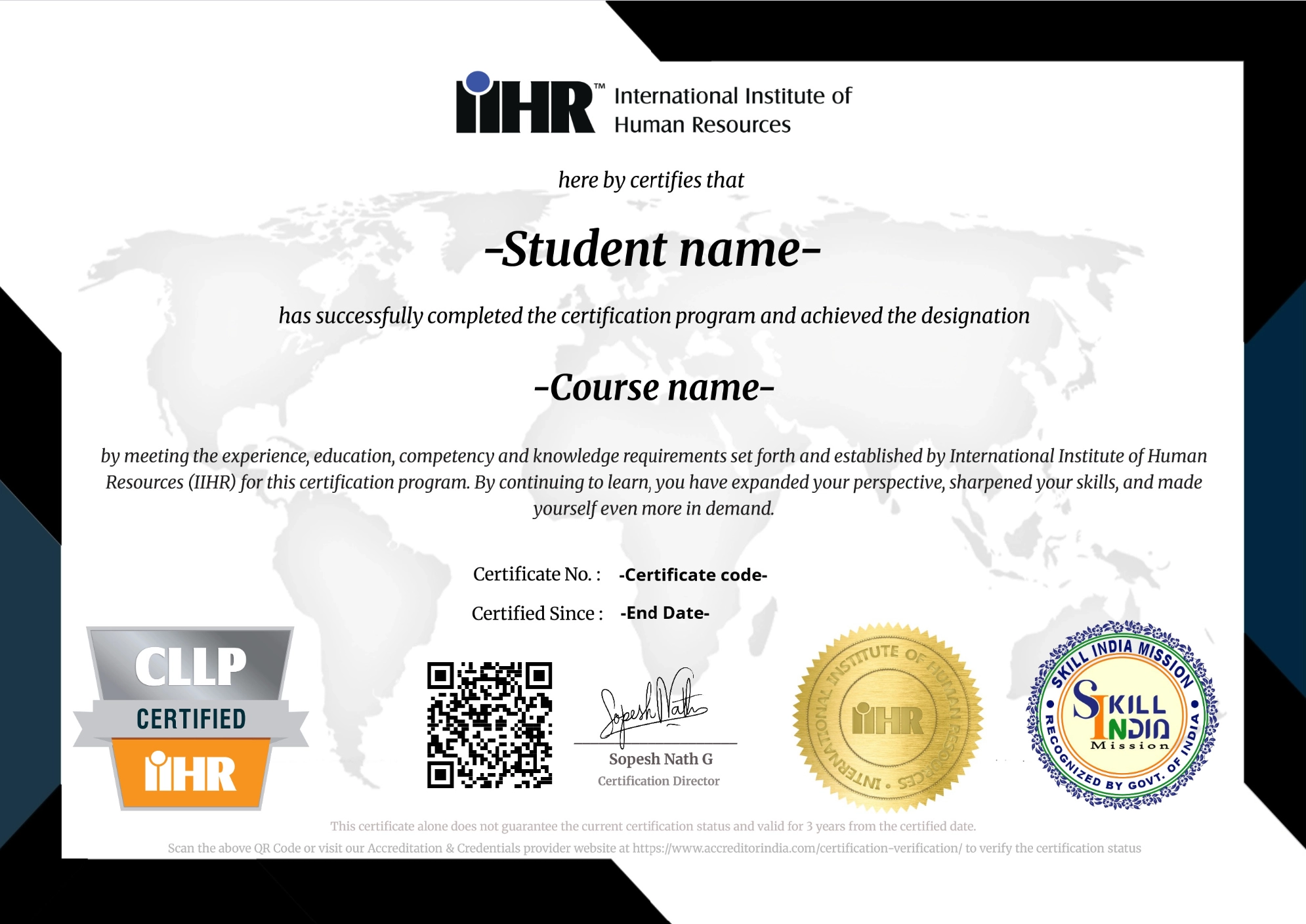
You will receive an Internationally Accredited Digital Certificate, valid for 3 years.
You will also receive a Digital Badge that you can share on:
LinkedIn
Email signatures
Resumes
Portfolios and websites
After 3 years, certification renewal requires appearing for the recertification online exam.
| Internationally Accredited Certificate | Official Digital Badge |
|---|---|
Digital Certificate – Valid for 3 Years Issued upon successful completion. Internationally accredited and verifiable. |
Shareable Digital Badge – Valid for 3 Years Can be added to LinkedIn, CVs, emails, and professional profiles. |
| Recertification required after 3 years. | Recertification required after 3 years. |

Certification Validity, Membership & Renewal Policy
Our Internationally Accredited Certifications, accredited under the ISO/IEC 17024:2012 standard, are designed to ensure that certified professionals maintain current knowledge and competency throughout their careers.
To preserve the integrity and global recognition of these credentials, the following certification policies apply:
Lifetime Learning Portal Access
Participants will receive lifetime access to the learning portal, including course materials and resources, for as long as their IIHR Membership remains active.
An active membership allows learners to revisit course content, refresh their knowledge, and stay updated with future learning resources published by IIHR.
Certification Validity
All internationally accredited certifications are valid for three (3) years from the date of certification.
To maintain an active certification status, certified professionals must renew their certification every three years.
Certification Renewal
Certification may be renewed by:
- Successfully completing the Certification Renewal Examination, and
- Paying the applicable Certification Renewal Fee of USD $100.
Upon successful renewal, the certification validity will be extended for another three (3) years.
Expired Certifications
If a certification is not renewed before its expiry date:
- The certification status will become Expired.
- The learner’s certification privileges and digital credentials may be suspended.
- Access to certification-related benefits may be revoked.
- To regain active certification status, the learner must:
- Complete the Certification Renewal Examination.
- Pay the applicable Renewal Fee of USD $100.
Membership Requirement
Maintaining an active IIHR Membership is mandatory to continue enjoying lifetime access to the learning portal and member benefits.
If membership expires or is not renewed:
- Learning portal access may be suspended.
- Member-exclusive resources and benefits will no longer be available until membership is renewed.
Certification Examination Completion Policy
After enrolling in an internationally accredited certification program, learners are required to complete the certification examination within three (3) months from the date of enrollment.
If the certification examination is not completed within the prescribed period:
- Examination access will automatically expire.
- The learner’s certification portal access may be suspended.
- To reactivate examination access, the learner must pay the Certification Examination Reactivation Fee of USD $100.
Once the examination access is restored, the learner will be provided with a new examination eligibility period in accordance with IIHR’s certification policies.
Continuous Professional Development
IIHR encourages all certified professionals to continuously update their knowledge and skills throughout their careers. Regular recertification helps ensure that certified professionals remain aligned with current industry practices, emerging technologies, changing regulations, and internationally accepted professional standards.
-
1
 1. Why You Need to be Very Strong in Labour Laws
 -
22. Basics of Legal
-
33. Self-Assessment
-
44. List of Key Acts
-
55. Bonded Labour System (Abolition) Act, 1976
-
66. Child and Adolescent Labour (Prohibition and Regulation)
-
77. Contract Labour (Regulation and Abolition) Act, 1970
-
88. Employee Provident Fund Act 1952
-
99. Employee State Insurance Act 1948
-
1010. Equal Remuneration Act, 1976
-
1111. Industrial Employment Act 1946
-
1212. Minimum Wages Act 1948
-
1313. POSH Act 2013
-
1414. Sexual Harassment Of Women At Workplace Act

-
151. Introduction
-
162. Background
-
173. Overview of Labour Codes
-
184. Code on Wages
-
195. Parts of the Code
-
206. Challenges
-
217. Code on Social Security
-
228. Meaning of Concepts
-
239. Important Provisions
-
2410. Benefits Offered
-
2511. OSHW Code
-
2612. Provisions
-
2713. Overview of IR Code
-
2814. Important Provisions
-
2915. Provisions and Requirements
-
3016. Summary
-
311 Why Labour Laws and Compliance knowledge Matters
-
322 Introduction to Labour Laws Legal Basics Every HR Must Know
-
333 Key Legal Terminologies in Labour Law and Statutory Compliance
-
344 Self-Assessment Code on Wages 2019 – Test Your Knowledge
-
355 Code on Wages 2019 Introduction and Scope Explained
-
366 Bare Acts
-
377 Code on Wages 2019 Key Definitions and Preliminary Provisions
-
388 Minimum Wages Under Code on Wages 2019 Rules and Compliance
-
399 Payment of Wages Timelines, Modes and Employer Obligations
-
4010 Payment of Bonus Eligibility, Calculation and Compliance
-
4111 Advisory Board Under Code on Wages Role and Functions
-
4212 Dues, Claims and Audit Under Code on Wages 2019
-
4313 Inspector-cum-Facilitator Powers and Compliance Checks
-
4414 Fines and Deductions What Employers Can and Cannot Do
-
4515 Miscellaneous Provisions of the Code on Wages 2019
-
4616 Recap Code on Wages 2019 – Key Takeaways for Compliance
-
4717 Practical FAQs on Code on Wages 2019 Common HR and Payroll Questions
-
4818 Self-Assessment Industrial Relations Code 2020
-
4919 Industrial Relations Code 2020 Overview and Key Changes
-
5020 Industrial Relations Code 2020 Definitions and Applicability
-
5121 Bi-partite Forums Worker-Management Dialogue Under IR Code
-
5222 Trade Unions in India Rights, Registration and Compliance
-
5323 Standing Orders Drafting and Compliance Under Industrial Relations Code 2020
-
5424 Notice of Change Employer Obligations Under Industrial Relations Code 2020
-
5525 Voluntary Arbitration of Industrial Disputes Process and Rules
-
5626 Resolving Industrial Disputes Tribunals, Conciliation and Law
-
5727 Strikes and Lock-outs Legal Provisions Under Industrial Relations Code 2020
-
5828 Lay-off, Retrenchment and Closure Legal Steps for Employers
-
5929 Worker Re-skilling Fund Employer Contributions and Compliance
-
6030 Unfair Labour Practices What Employers Must Avoid
-
6131 Offences and Penalties Under Industrial Relations Code 2020
-
6232 Practical FAQs on Industrial Relations Code 2020
-
6333 Recap Industrial Relations Code 2020 – HR Compliance Summary
-
6434 Self-Assessment Code on Social Security 2020
-
6535 Code on Social Security 2020 Overview for HR and Payroll
-
6636 Social Security Code 2020 Definitions and Applicability
-
6737 Social Security Organisations under Code on Social Security, 2020
-
6838 Provident Fund (PF) Under Social Security Code 2020 Compliance Guide
-
6939 Employee State Insurance Corporation (ESIC) Under Social Security Code 2020
-
7040 Gratuity Rules in India Eligibility, Calculation and Compliance
-
7141 Maternity Benefits Under Social Security Code 2020
-
7242 Employee's Compensation Rights and Employer Liability
-
7343 Social Security for Gig Workers, Platform Workers and Unorganised Sector
-
7444 Penalties on Employer Under Social Security Code 2020
-
7545 Practical FAQs on PF, ESI, Gratuity and Social Security Compliance
-
7646 Self-Assessment Occupational Safety Health and Working Conditions Code 2020
-
7747 OSH Code 2020 Introduction to Occupational Safety Law in India
-
7848 OSH Code 2020 Definitions, Scope and Applicability
-
7949 Factory and Establishment Registration Under OSH Code 2020
-
8050 Duties of Employer and Employees Under OSH Code 2020
-
8151 Occupational Safety and Health Standards Compliance Requirements
-
8252 Health, Safety and Working Conditions for Employees
-
8353 Welfare Provisions Under OSH Code 2020 What Employers Must Provide
-
8454 Working Hours and Paid Annual Leave OSH Code Compliance
-
8555 Statutory Registers, Records and Returns Under OSH Code 2020
-
8656 Women at Workplace Special Provisions Under OSH Code 2020
-
8757 Contract Labour Compliance Under OSH Code 2020
-
8858 Inter-State Migrant Workers Legal Protection Under OSH Code
-
8959 Offences and Penalties Under OSH Code 2020
-
9060 POSH Act 2013 Purpose and Why Every Organisation Needs It
-
9161 History of Sexual Harassment Law in India From Vishaka to POSH
-
9262 POSH Act Applicability Who Is Covered and Where It Applies
-
9363 Defining Sexual Harassment at Workplace Under POSH Act 2013
-
9464 Types of Sexual Harassment Quid Pro Quo vs Hostile Work Environment
-
9565 Real Workplace Scenarios Identifying Sexual Harassment Under POSH
-
9666 How to Constitute an Internal Complaints Committee (ICC) Under POSH
-
9767 Powers and Functions of ICC Under POSH Act 2013
-
9868 POSH Complaint Process Filing, Investigation and Timelines
-
9969 Employer Penalties for Non-Compliance Under POSH Act 2013
-
10070 Rights of the Respondent in POSH Complaints
-
10171 FAQs on POSH Act 2013 Common Questions Answered
-
10272 POSH Compliance Checklist for Employers and HR Teams
-
10373 POSH Policy Template How to Draft a Sexual Harassment Policy
-
10474 Apprentices Act 1961 Compliance Guide for Employers
-
10575 Bonded Labour Abolition Act 1976 Key Provisions and Employer Duties
-
10676 Child and Adolescent Labour ( Prohibition and Regulation) Act, 1986
-
10777 Labour Welfare Fund (LWF) Applicability, Contribution and Compliance
-
10878 Professional Tax in India State-wise Applicability and Deductions
-
10979 Shram Suvidha Portal Registration Step-by-Step Guide for Employers
-
11080 Filing Annual Return on Shram Suvidha Portal Process Explained


HR professionals (0–20 years experience)
HR managers and executives
Entrepreneurs and business owners
Top management professionals
Anyone interested in labour law compliance
Key labour laws and statutory compliances
Employee benefits like PF, ESI, Bonus, Gratuity
Workplace legal scenarios and dispute handling
Employee and employer rights
Compliance requirements in HR functions
Legal awareness in HR
Compliance management skills
Risk handling and decision-making ability
Confidence in handling workplace legal issues
HR Executive
HR Compliance Officer
Labour Law Consultant
HR Operations Executive
Important Notices
This is a self-paced, skill-based program focused on performance management and appraisal practices used in organizations.
Get 3 years of LMS Portal access, renewable upon recertification and Course access is provided from the date of enrollment.
Participants are responsible for completing the course within 3 months and take the online the examination to get the certificate and digital badges.
This program provides a Globally Accredited Certification and is valid for 3 years only.
No prior HR experience is required; however, a basic understanding of HR concepts is beneficial.
This course is designed for practical skill development in performance management and does not guarantee job placement.
Placement opportunities, if any, depend on individual skills, performance, and market conditions.
IIHR reserves the right to update course content, structure, or access policies as per industry requirements.

Eligibility Criteria
- Open to all
- Suitable for beginners and professionals
- No prior legal knowledge required
- Basic understanding of HR (preferred)
- Internet access for learning
- HR professionals (0–20 years experience)
- HR managers and executives
- Entrepreneurs and business owners
- Top management professionals
- Anyone interested in labour law compliance
Career Opportunities
After completing this course, you can apply for roles such as:
- HR Executive
- HR Compliance Officer
- Labour Law Consultant
- HR Operations Executive
Career Benefits
- Gain strong legal knowledge in HR
- Improve compliance handling skills
- Reduce organizational legal risks
- Enhance career growth and credibility
Career Counselling
Get personalized guidance to choose the right HR career path.
For a free career counselling session, call us at +91 7037034447 or click below to connect with us on WhatsApp.

We also recommend visiting our campus to interact directly with our Program Director for in-depth career guidance.